If you’ve ever stood in a stuffy conference room where the air conditioning felt like it was blowing too hard in one corner and not enough in another, or walked past a industrial warehouse where dust and stale air lingered despite the ventilation system humming, you’ve experienced a problem balancing airflow. As someone who’s worked as an air damper supplier for over a decade, I’ve spent countless hours walking through facilities with facility managers, HVAC technicians, and even small business owners who don’t always grasp what an air damper does—let alone how a balancing air damper, the most versatile type we sell, solves those messy, everyday ventilation headaches. Let me walk you through how they work, why they’re different from basic dampers, and why they matter for every space that needs consistent air flow. Air Damper
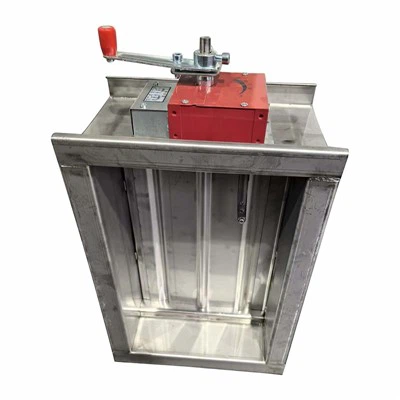
First, let’s start with the basics: what is an air damper, period? At its core, it’s a device that regulates airflow within ductwork—the metal or fiberglass tubes that carry heated or cooled air through buildings. Think of ductwork like a set of pipes for air: if you need more water in one faucet, you turn the faucet handle; a damper does the same for air, but with far more precision. Now, a balancing air damper (sometimes called a volume damper or zone balancing damper) is not the flimsy, manually adjusted flap you might find in a cheap window vent. It’s a calibrated, often motorized device designed to fine-tune the amount of air moving to specific zones of a building, so no room gets shortchanged or overwhelmed.
Let’s break down the internal anatomy to make this real. Every balancing air damper has a few core parts that work together like a well-orchestrated team. The main component is the damper blade—usually a thin, durable metal (galvanized steel or aluminum, for commercial use) that sits inside the duct, pivoting on a central axis. Around the blade, you have a frame that’s flush with the inside of the duct, so it doesn’t create extra drag or disrupt airflow when the blade is fully open. Then there’s the actuator: this is the part that moves the blade. For basic balancing, some are manually operated (a simple lever that technicians turn to a specific angle and lock in place), but most modern ones use an electric or pneumatic actuator that can adjust the blade position automatically.
Here’s where the balancing part comes in, and why it’s not just “opening and closing a flap.” When your HVAC system runs, it moves a fixed volume of air—let’s say 10,000 cubic feet per minute (CFM) for a small office building. If all of that air was pushed straight into the main lobby, the upstairs offices would get almost nothing, and the lobby would be freezing or sweltering. A balancing air damper fixes that by acting like a traffic cop: you set each damper to a specific CFM rating, so air is split exactly where it’s needed. For example, a 1,000 square foot private office might need 150 CFM, so you set its damper to 150 CFM; a 5,000 square foot warehouse bay might need 800 CFM, so its damper is calibrated to that.
Wait, but how do you actually measure that CFM? That’s where the science of static pressure comes in, and it’s the secret that makes balancing dampers work so well. Static pressure is the pressure of air inside the duct, not the force of the air blowing out the vent. Think of it like the water pressure in your shower: if the pressure is too low, the shower is weak; too high, it’s too forceful. HVAC systems have a set static pressure they’re designed to operate at, and when you adjust a balancing damper, you’re altering that pressure in each section of duct to control airflow. When a damper’s blade is partially closed, it creates a small pressure drop, which restricts how much air can flow through that duct branch. When it’s fully open, there’s almost no pressure drop, so air flows unobstructed.
Here’s a real example I run through with every client: last year, a restaurant owner called me because their dining room was freezing, but the kitchen (which had its own HVAC branch) was uncomfortably hot. Their existing dampers were flimsy metal flaps that someone had bent by hand, so they couldn’t hold a consistent position. We installed balancing air dampers on each duct branch leading to the dining room and kitchen. The technician measured static pressure in both ducts, calibrated the dining room damper to maintain a 0.8 inch water column static pressure (the ideal for their duct size) and the kitchen damper to 0.5 inches. Within a week, the dining room temperature stabilized at 72 degrees, and the kitchen stayed at 75 instead of spiking to 80. That’s the impact of a properly calibrated balancing damper, not just a generic damper.
Now, let’s clear up a common misconception: balancing dampers aren’t just for big commercial buildings. A lot of people think they’re only for factories or skyscrapers, but they work just as well in small offices, retail stores, even home addition projects. Let’s say you add a sunroom onto your house and you want the central AC to cool it evenly with the rest of the home. Without a balancing damper, the sunroom’s duct would pull too much air because it’s an extra branch, leaving the main rooms short. A small, manually adjusted balancing damper in the sunroom’s duct lets you restrict airflow just enough to keep the whole house at a consistent temperature.
Another key feature of modern balancing air dampers is their ability to work with smart HVAC systems. Many of the dampers we supply have electric actuators that connect to your building’s BACnet or Modbus network, so you can adjust airflow remotely. For example, if a retail store is closed on Sundays, you can program the dampers to reduce airflow to the stock room by 50% to save energy, while keeping the front of the store at a comfortable temperature for any staff working. That’s a huge benefit over old-style dampers that required someone to physically go into the ductwork to adjust them.
But how do you make sure a balancing damper is actually working, not just sitting in the duct? That’s where the testing part comes in, which our technicians do every time we install a damper. We use a manometer to measure static pressure in each duct, then cross-reference that with the CFM rating on the damper. If a damper is set to 200 CFM, we confirm that the air flowing out of the vent is indeed 200 CFM. If it’s too high, we turn the blade a little more closed; too low, we open it a bit. This is called “air balancing,” and it’s the step that turns a random damper into a balancing damper that does its job.
I’ve seen a lot of mistakes in the industry: technicians will install a generic damper and call it a balancing damper, but without calibration, it’s just a flap. The difference is in the precision. Our balancing air dampers have adjustable blade stops, so they can be set to exact angles (not just “open” or “closed”) and many have built-in flow ports that let you easily measure airflow without having to remove the duct cover. That saves hours of labor for technicians, which is why so many clients come back to us for replacements or upgrades.
What about maintenance? Balancing dampers are surprisingly low-upkeep, which is another reason they’re so popular. The metal frames and blades resist rust and corrosion (even in damp environments like laundries or pool facilities), and the actuators are sealed to keep out dust and debris. Every few years, all you need to do is check that the blade moves smoothly, clean any dust buildup on the frame, and recalibrate if your HVAC system has been modified (like adding on a new wing or changing your furnace size). We send a free maintenance checklist with every damper we sell, so clients don’t have to guess what to do.
Let’s talk about a common problem we solve: air imbalance in multi-story buildings. On the top floor of a tall office building, hot air rises, so the top rooms are always hotter than the ground floor. A balancing air damper on each floor’s duct lets you restrict airflow to the top floors a little, so the cooled air from the HVAC system doesn’t all get trapped there, and more air flows to the lower floors. It’s a simple fix that makes a huge difference in comfort for everyone. I worked on a 12-story office building downtown last year where the top floor was 10 degrees hotter than the rest; after installing balancing dampers on each floor and adjusting each one’s CFM, the temperature difference dropped to just 1 degree. That’s not a minor fix—that’s improving the quality of work for hundreds of employees.
Now, let’s address a question I get all the time: why not just adjust the fan speed on the HVAC system instead of using dampers? It’s a good question, and the short answer is that fan speed adjustment is for overall airflow, while dampers are for zone-specific. If you lower the fan speed to fix the top floor being too hot, you might end up with the ground floor having almost no airflow. Dampers let you fine-tune each area without messing with the whole system’s efficiency. Also, running a fan at a lower speed when you don’t need full airflow saves energy, so balancing dampers actually lower utility bills for our clients. A small retail store might save $500 a year on energy costs with properly balanced dampers; a large warehouse can save $5,000 or more. That’s a return on investment most businesses see in less than two years.
Wait, but what about when a damper goes bad? Even the highest quality dampers can wear out over time, especially if they’re adjusted frequently. A common sign is uneven airflow: one day a room is blowing too hard, the next it’s too soft, and the damper blade won’t stay in place. That’s when it’s time to replace it with a balancing air damper—don’t try to fix it with a random flap from a hardware store. We’ve had clients who tried to use a generic damper as a replacement, and within six months, they were back with the same imbalance issue. Our dampers are engineered to hold their calibration, so they last 10 to 15 years with minimal maintenance.
Let’s wrap this up with a clear breakdown of how a balancing air damper works, step by step, so you can visualize it: 1. The HVAC system pushes air through ductwork, with a fixed static pressure. 2. A balancing damper is installed in each branch duct leading to a specific zone. 3. A technician measures the required airflow for each zone (based on room size, number of people, equipment heat output). 4. The damper blade is calibrated to an angle that creates the exact pressure drop needed to deliver that airflow. 5. The actuator (manual or automatic) holds the blade in that position, so airflow stays consistent. 6. If the HVAC system’s overall pressure changes (like when the furnace turns off and the AC turns on), the dampers adjust automatically to maintain the zone airflow. 7. Periodic testing and recalibration ensures the system stays balanced over time.
If you’re dealing with uneven airflow in your building, paying too much for energy, or just want to make your space more comfortable, the right balancing air damper is the solution. Every building is different, and every zone has unique needs, so a one-size-fits-all damper won’t work—that’s why we work with clients to size and customize dampers for their specific ductwork and HVAC system. We don’t just sell parts; we help figure out what your space needs to run efficiently.

If you’re ready to fix your airflow issues and get consistent comfort and lower energy costs, reach out to us to discuss your project. Whether you’re a small business owner looking to upgrade your retail space or a facilities manager for a large industrial complex, we can provide the balancing dampers and support you need to get your system working right.
Air Conditioning Unit References
- HVAC Air Balance Manual: NEBB (National Environmental Balancing Bureau) Standards for Balancing and Testing HVAC Systems, 2021
- ASHRAE Handbook: HVAC Systems and Equipment, Chapter 20 – Air Distribution, 2022
- Balancing Dampers: Design and Installation Guide, Sheet Metal and Air Conditioning Contractors’ National Association (SMACNA), 2020
Jiangsu Hengyu Fire Protection Technology Co., Ltd.
We’re well-known as one of the most experienced air damper manufacturers in China, also support customized service. With abundant experience, we warmly welcome you to buy bulk discount air damper from our factory. If you have any enquiry about quotation, please feel free to email us.
Address: Jiangsu Hengyu Fire Protection Technology Co., Ltd., No.56, Xinyi Road, Chengbei Industrial Park, Jingjiang City, Jiangsu Province
E-mail: Jskyxfkj@163.com
WebSite: https://www.cehengyu.com/
