If you’ve ever walked through a metal fabrication shop, you’ve likely seen rows of milling machines humming away, shaping solid blocks of metal into parts for cars, aerospace components, or even everyday tools. But if you stopped to ask the operators or the shop foreman which machine they’re using, they might not just say “milling machine”—they’d specify whether it’s a universal milling machine or a plain milling machine. As a milling machine supplier, I’ve heard this question hundreds of times, and it’s one that trips up a lot of new machinists and small shop owners looking to invest in their first or next machine. The difference isn’t just technical jargon; it’s the line between a machine that can handle simple, repetitive jobs and one that takes on complex, custom work. Let’s break it down so you can make the right choice for your shop. Milling Machine

First, let’s start with the basics: what a milling machine does, in case you’re new to the space. Milling machines use a rotating cutter to remove material from a workpiece, which is secured to a table that can move in multiple directions. Unlike a lathe, which spins the workpiece, milling machines spin the cutter, letting you create flat surfaces, slots, gears, threads, and even curved shapes. Both universal and plain milling machines fall into the category of horizontal milling machines—meaning their cutter spindle runs parallel to the worktable, which sets them apart from vertical milling machines that use a vertical spindle. But that’s where the similarities end.
Let’s talk about plain milling machines first, because they’re the workhorses of high-volume, low-complexity jobs. A plain milling machine has a fixed, rectangular worktable that moves in only three directions: forward and backward (longitudinal), left and right (cross), and up and down (vertical). That’s it—no extra axes, no swiveling parts. Their spindle is fixed in a single horizontal position, and they typically use a single arbor to hold the milling cutter, which means you can’t easily swap cutters at angles or adjust the orientation of the cutter relative to the workpiece without resecuring the part.
What makes plain milling machines shine is their simplicity and speed for repetitive, uniform tasks. If you’re producing hundreds of identical metal brackets that need a single slot milled along their edge, or flat surfaces on a batch of steel plates, a plain machine is perfect. They’re more affordable than their universal counterparts, require less maintenance, and are faster to set up for these straightforward jobs. But here’s the catch: their fixed table and rigid spindle orientation mean you’re limited to straight cuts along the axes, and you can’t easily adjust the angle of the workpiece or cutter mid-job. That’s where universal milling machines step in.
A universal milling machine is basically a plain milling machine upgraded with two key features that turn it into a versatile workhorse for custom and complex work. First, its worktable doesn’t just move in three linear directions—it can also swivel horizontally around the spindle axis, usually up to 45 degrees in either direction. Second, many universal machines also allow the spindle itself to be tilted vertically, adding even more flexibility. Wait, let’s clarify that: the swiveling table is the defining difference. On a plain machine, the table is locked in a fixed horizontal plane, so you can only cut parallel or perpendicular to the machine’s main axis. On a universal machine, you can rotate the table to, say, 15 degrees, and mill a helical gear or a tapered slot without repositioning the workpiece. That’s a game-changer.
Let me give you a real example from a client of mine who makes custom gears for small farming equipment. They originally used a plain milling machine, but when they got a contract to produce a batch of helical gears, they had to send the work out to a shop with a universal machine because their plain machine couldn’t swivel the table to the required angle. Once they upgraded to a universal milling machine, they brought that work in-house, cutting lead times by 30% and saving thousands in outsourcing costs. Another common use case for universal machines is milling splines on shafts—those notches that let a pulley grip a rotating shaft. With a plain machine, you’d have to mill each spline individually, resecuring the shaft every time, but a universal machine can swivel the table and move the cutter in a way that mills all splines on a single setup.
Now, it’s not that universal machines are always better. For high-volume, straightforward jobs where flexibility isn’t needed, plain machines still win. Let’s say you run a shop that makes metal fasteners or repeat cuts for construction parts. A plain milling machine is cheaper, takes up less space, and is easier for new machinists to operate, since there are fewer moving parts to adjust. But if your shop is taking on custom jobs, prototyping, or any work that requires angles, curves, or non-linear cuts, a universal milling machine is worth the investment.
Let’s get a bit more technical to back this up, because when you’re comparing equipment, specs matter. Plain milling machines typically have a power range of 1.5 to 7.5 horsepower, depending on the model, with a spindle speed range of around 60 to 1500 RPM. They’re built for heavy cuts on uniform materials, with a rigid frame that minimizes vibration during repetitive work. Universal milling machines, on the other hand, usually have a similar power range but add precision features like graduated dials for swiveling the table to an accuracy of 0.01 degrees, and many come with digital readouts (DROs) to make angle adjustments easier. Some universal machines also have a quill feed, which lets you move the cutter in and out for deeper cuts without adjusting the table, a feature rarely found on plain machines.
Another key difference is setup time. With a plain machine, setup is fast: you secure the workpiece, align the table, lock all axes, and start cutting. But any time you need a different angle, you have to unclamp the table, reposition it, and remeasure—this adds minutes or even hours to each job. On a universal machine, the swiveling table is locked in place, so you can set the angle once and mill multiple parts without rechecking, which is a huge time saver for jobs with angular cuts. That said, the extra features of a universal machine mean they require more training to operate. A new machinist can learn a plain machine in a day, but a universal machine might take a week or two, since you have to learn how to adjust the swivel, use the DRO, and align the cutter at different angles.
As a supplier, I see a lot of shops make the mistake of buying a universal machine when they don’t need it, or sticking with a plain machine when their workload is growing into more complex jobs. Let’s walk through a quick checklist to help you decide:
- If you’re producing 500+ identical parts with straight cuts: plain milling machine is the better choice. Lower upfront cost, less maintenance, faster for high volume.
- If you do custom work, prototyping, or jobs with angles, helical cuts, or non-linear shapes: universal milling machine will pay for itself in less than a year from outsourcing savings.
I’ll also mention that there are hybrid models out there, sometimes called “plain universal” milling machines, which offer a limited table swivel (usually up to 10 degrees) instead of the full 45 degrees. These are a great middle ground for small shops that occasionally need a slight angle but don’t want to pay for a full universal machine. But if you’re regularly handling helical gears, splines, or tapered cuts, you need that full 45-degree swivel.
Now, let’s talk about what to look for when shopping, since I know as a supplier, you’re looking for machines that hold up. For plain milling machines, prioritize a solid cast iron frame—this reduces vibration during heavy cuts—and a reliable arbor system that holds cutters securely. For universal machines, check the swivel mechanism: it should lock tightly without play, and the DRO should have clear, easy-to-read dials. We’ve seen too many universal machines where the table swivels slightly under heavy load, leading to inaccurate cuts, so quality of the swivel assembly is key.
A recent project that stands out: a small aerospace prototype shop came to us last year with a plain milling machine that could only handle simple aluminum brackets, but their new contract required custom turbine blades with curved edges. We helped them upgrade to a universal milling machine, and they told us within six months that the machine had let them take on $200k worth of work they would have had to turn down before. That’s the real value of understanding the difference between these two machines—it’s not just about specs; it’s about unlocking new revenue for your shop.
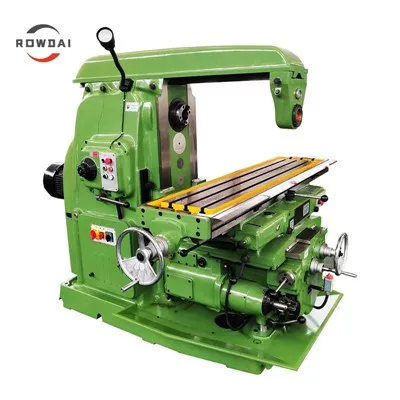
If you’re still unsure which one is right for your needs, don’t hesitate to reach out to us to discuss your workload, job types, and budget. We’ve helped hundreds of shops across industries select the right milling equipment, and we can walk you through the pros and cons specific to your business. Whether you’re just starting out and need your first machine, or you’re looking to upgrade to handle more complex work, we’re here to help you make an informed choice that fits your long-term goals.
Surface Grinding Machine References
- DeVries, W. R. (2015). Metal-Machining Theory and Applications. Pearson Education.
- Kalpakjian, S., & Schmid, S. R. (2020). Manufacturing Processes for Engineering Materials. Pearson.
- Modern Machine Shop. (2022, July 12). Milling Machines 101: Types and Capabilities. Retrieved from industry publications on manufacturing equipment.
Henan Rowdai Machinery Equipment Co., Ltd.
As one of the most professional milling machine manufacturers in China, we’re featured by quality products and good price. Please rest assured to buy high-grade milling machine for sale here from our factory. If you have any enquiry about cooperation, please feel free to email us.
Address: Building 9, E-Commerce Industrial Park, High-Tech Zone, Zhengzhou, Henan, China
E-mail: rowdai@rowdai.com
WebSite: https://www.rowdai.com/
